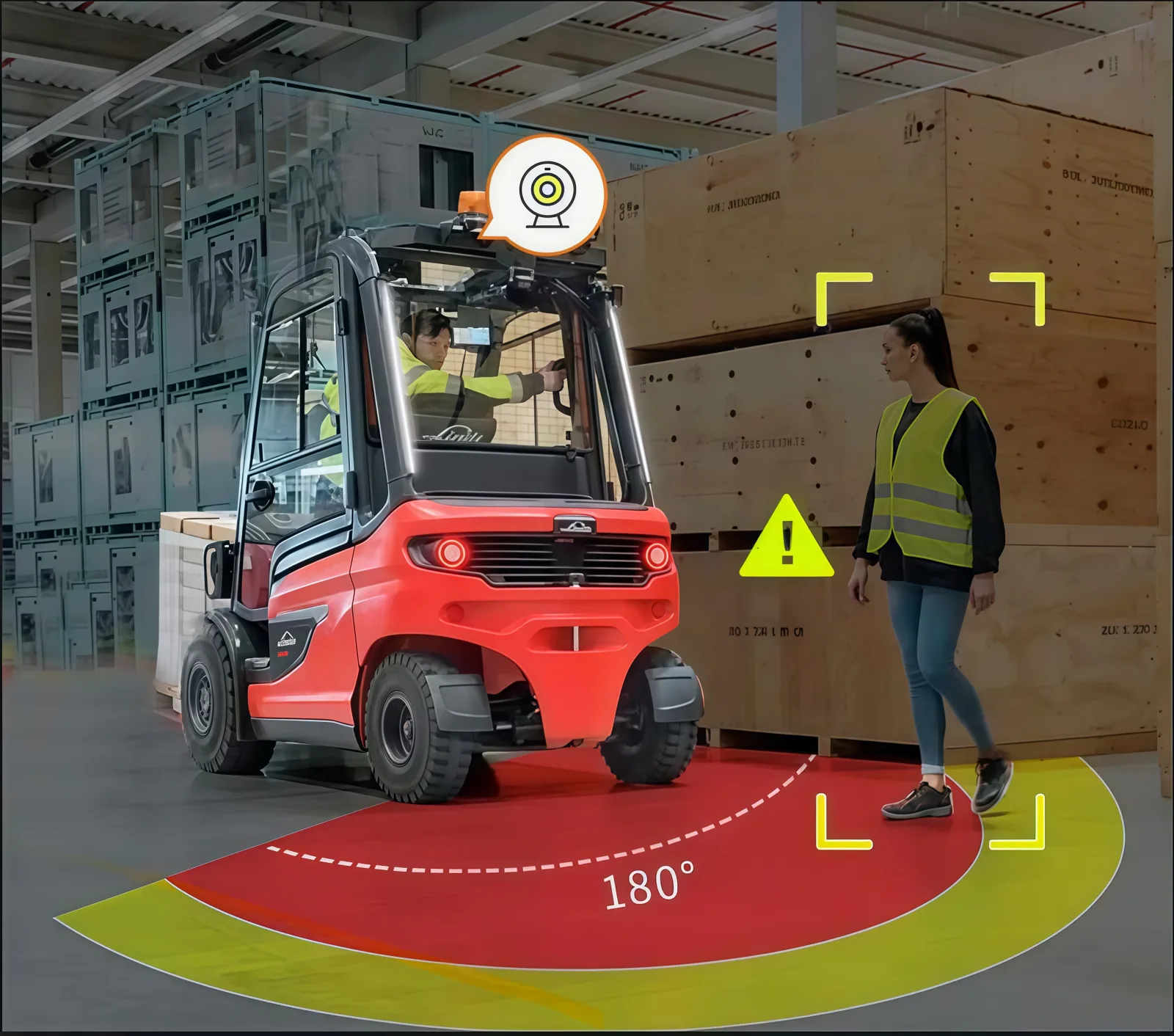
Short answer: an AI pedestrian detection camera analyses the scene around a forklift, identifies people inside configured risk zones and alerts the operator. Where the vehicle and risk assessment allow it, an output can also support an automatic stop function. The pedestrian does not need to carry a tag.
This is a visual safety layer for the areas that mirrors, direct sight and normal operator awareness do not cover consistently. It is particularly relevant during reversing, tight manoeuvres, work beside racking and other mixed-traffic situations.
The camera does not make the rest of workplace transport safety optional. The UK Health and Safety Executive says sites should separate pedestrians and vehicles wherever reasonably possible and should use suitable routes, crossings, lighting and training. Camera detection addresses residual exposure where people and vehicles can still meet.
From a camera frame to an operator warning
A useful way to understand the system is as four linked decisions. Each one has to be configured for the actual vehicle and route rather than assumed from a generic drawing.
- Capture the vehicle surroundings. One or more industrial cameras view the selected rear, side or front approaches. The mounting point, field of view and protection of the lens matter as much as the camera itself.
- Identify a person in the image. The on-board processing looks for a pedestrian visually. Because detection is based on the image, visitors and contractors do not need a wearable badge to be visible to the system.
- Compare the detection with configured zones. A person outside the relevant area should not produce the same response as a person entering the vehicle path. Zone geometry turns a general detection into site-specific alert logic.
- Warn or provide an output. The system can present visual and audible warnings to the operator. A separate alarm output can support approved stop logic after the vehicle circuit and operating risk have been assessed.
This chain explains why an installation is not complete when hardware is merely bolted to a truck. Commissioning must confirm what the camera can see, how the zones align with the vehicle path and what response operators are expected to make.
Why warning zones and critical zones are separate
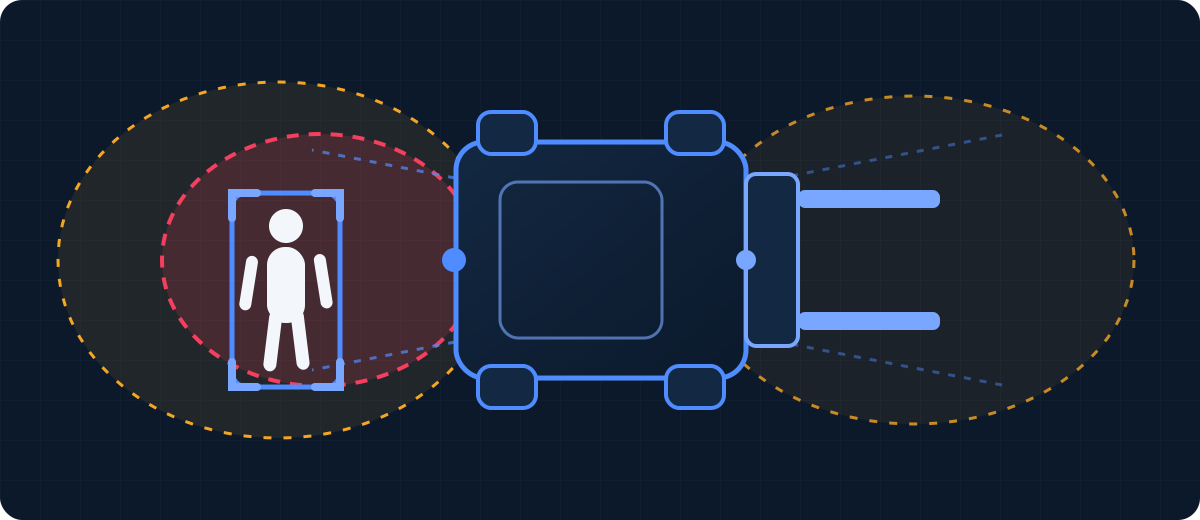
A single detection boundary often gives the operator too little context. A two-stage layout can distinguish an early approach from a person entering a critical area near the planned vehicle path.
Early-warning zone
The outer zone gives the operator time to look, slow down and reassess the manoeuvre. Its job is not to create constant noise. It should match the route geometry and the way people actually move through the area.
Critical zone
The inner zone represents the more urgent condition. It can trigger a stronger visual or audible warning. If the vehicle is suitable and the engineering assessment supports it, this state can also provide the signal used by an approved stop-system integration.
The distinction matters because poor calibration creates two different problems. Zones that are too broad can produce frequent non-actionable alarms. Zones that are too narrow can leave insufficient time for a meaningful response. A pilot should test both ordinary work and less frequent movements such as loading, waste handling and shift changes.
What the operator should experience
An alert should answer a practical question: does the operator need to look, slow down or stop the manoeuvre? That means the monitor position, sound level and warning sequence have to make sense inside the cab, with the engine running and the normal task in progress.
Training should explain the meaning of each alert and the action expected from the operator. It should also explain what the system does not see. Operators must continue the site's normal observation and vehicle-control procedures even when camera warnings or an assessed stop output are available.
During a pilot, collect examples of useful warnings and nuisance warnings. Review them with operators instead of judging the system from a staged demonstration alone. Their feedback helps reveal whether the zones reflect the real route and whether the alert is clear enough to change behaviour without becoming background noise.
How tagless visual detection differs from RFID and UWB
Tag-based proximity systems detect a relationship between equipment fitted to the vehicle and a compatible tag carried by a person. Visual AI detection works from the camera image instead. Nothing has to be issued to the pedestrian for the camera to identify them inside the configured zone.
That difference changes the day-to-day operating model. Temporary workers, visitors and contractors can be detected without first receiving a badge. There are no tag batteries to charge or replace, and no inventory of wearables to distribute and collect.
This does not make one technology universally better. A site may have reasons to use tags, cameras or both. The practical question is which hazards, people and routes the chosen system must cover. If a safety case depends on every person carrying working equipment, tag control becomes part of that safety case. If it depends on visual detection, camera view, lens condition and zone calibration become part of it.
What a retrofit involves
A retrofit starts with the movement that creates the exposure, not with a target camera count. One camera may cover a single critical rear direction. Up to four cameras can be used when the assessment calls for rear, side and front coverage.
Vehicle survey
Record the truck type, attachment, load profile, blind spots, available mounting points and power or control interfaces.
Route observation
Map pedestrian desire lines, crossings, doors, racking corners, reversing points and times when traffic patterns change.
Response design
Define what the operator sees and hears, which zone creates each alert and whether a stop output is technically appropriate.
Commissioning
Test representative people, positions, routes and manoeuvres. Train operators on both the expected response and the limits of the system.
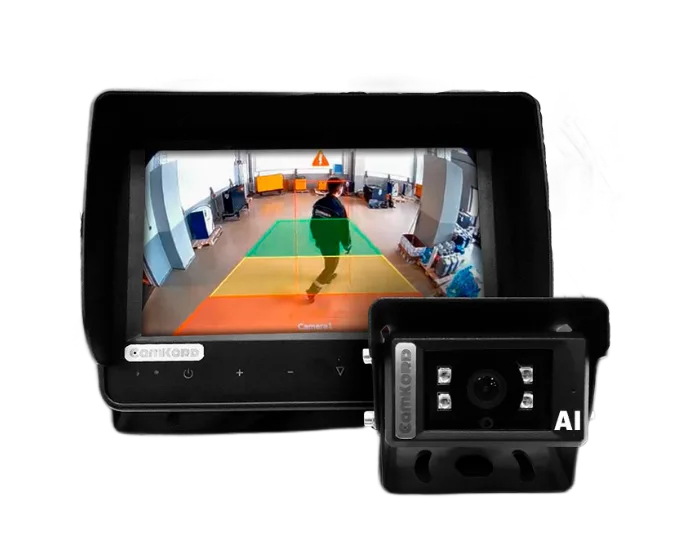
If automatic stopping is considered, the work extends beyond camera configuration. The vehicle control circuit, braking behaviour, intended operating state and safe failure response require an engineering assessment. The camera supplies an output; the complete safety behaviour belongs to the integrated vehicle system.
What the camera does not replace
AI pedestrian detection should sit inside a wider workplace transport system. It does not replace physical separation, competent operators, site rules, route design, suitable lighting, maintained vehicles or supervision.
The HSE guidance on separating pedestrians and vehicles describes separate routes as the most effective control wherever reasonably possible. Its workplace transport overview also recommends mapping vehicle and pedestrian movements, reducing contact points and considering less frequent activities.
Those principles help define the right role for a camera. It is most valuable where a residual blind spot or mixed-traffic interaction remains after higher-level controls have been applied. The project should state that boundary clearly so people do not treat the technology as permission to weaken traffic management.
A pilot checklist for one high-risk route
The most useful pilot is narrow enough to observe properly and real enough to show how the system behaves during work. Start with one vehicle and one route where the blind spot or pedestrian interaction is already understood.
- Describe the hazard and the existing controls before installing the camera.
- Record who can enter the area, including visitors, contractors and temporary staff.
- Map normal movements, reversing, loading, shift changes and uncommon tasks.
- Agree the early-warning and critical-zone response with operators and safety staff.
- Test camera position and zone geometry with representative manoeuvres.
- Check that alerts are noticeable but not so frequent that they lose meaning.
- Define routine lens inspection and what happens if the system is unavailable.
- Review operator feedback and observed behaviour before expanding the installation.
The success criterion should be operational clarity: the right people understand what the system sees, what each alert means and which risks remain outside its scope.